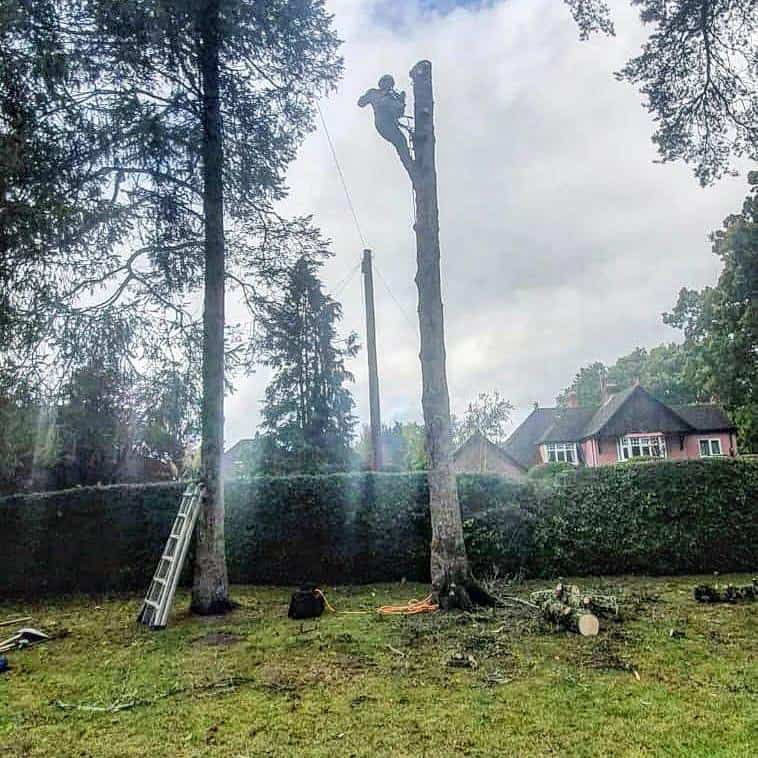
Crown reduction decreases the overall height or spread of a tree by shortening selected branches while retaining a balanced, natural-looking canopy. It can be useful when a tree has become too large for its position, developed overextended limbs or begun interfering with nearby garden features.
However, crown reduction is not a standard treatment that should be applied in the same way to every tree. The appropriate amount of growth to remove depends on the species, age, condition, structure and surroundings. Providing clear information before an assessment helps a tree surgeon understand the problem and recommend suitable work.
Information That Supports a Crown Reduction Assessment
A tree surgeon will need to inspect the tree before confirming whether crown reduction is appropriate. The following details can help make the initial discussion and site assessment more productive.
Why You Are Considering Crown Reduction
The most useful starting point is a clear explanation of the problem you want to resolve. Different objectives may require different pruning methods.
You may be concerned about:
- Long branches extending over a garden feature
- Excessive shade
- The tree becoming too large for its setting
- An uneven or unbalanced canopy
- Branches approaching a building
- Reduced clearance above a path or driveway
- Movement in overextended limbs
- Dense growth affecting the wider garden
Explaining the practical issue is more helpful than requesting that the tree simply be made smaller. It allows the tree surgeon to assess whether crown reduction, crown lifting, thinning or selective pruning would provide the best result.
The Tree’s Species
Different tree species respond to pruning in different ways. Some tolerate moderate reduction well, while others are more likely to develop stress, decay or vigorous regrowth after heavy cutting.
If you know the species, mention it when making contact. If you are unsure, clear photographs of the leaves, bark, overall shape and surrounding area may help with initial identification. The species will still need to be confirmed during the assessment.
The Tree’s Approximate Size
An estimate of the tree’s height and canopy spread helps indicate the scale of the work. Exact measurements are not expected, but it is useful to explain whether the tree is comparable in height to the property, extends across most of the garden or reaches over neighbouring features.
The tree surgeon will take a closer look on site, considering:
- Overall height
- Width of the crown
- Length of major branches
- Distribution of foliage
- Balance between different sides
- Clearance from surrounding features
These details influence how much reduction can be achieved without spoiling the tree’s structure.
The Location of the Problematic Growth
A tree may not need an even reduction across its whole canopy. The concern could relate to one long limb, a heavily weighted side or growth extending in a particular direction.
Identify which branches are causing difficulty and what lies beneath or beside them. This helps the tree surgeon decide whether selective branch reduction could solve the problem with less intervention.
Changes You Have Recently Noticed
Describe any recent changes in the tree’s appearance or behaviour. Relevant observations may include:
- Branches moving more noticeably in wind
- New cracks or splits
- Sections of dieback
- Falling twigs or branches
- Fungal growth
- Sparse foliage
- A canopy becoming uneven
- A branch lowering towards the ground
- Damage following severe weather
These signs may affect whether routine crown reduction is suitable or whether the tree first requires a closer structural assessment.
Previous Pruning Work
The tree’s pruning history can strongly influence its current structure. Previous reduction, topping or repeated cutting may have produced multiple regrowth points or weakly attached branches.
Tell the tree surgeon:
- When the tree was last pruned
- What type of work was completed
- Whether the canopy regrew quickly
- If branches have failed since the previous work
- Whether the same section has been reduced more than once
Old pruning points can sometimes be seen during an inspection, but background information provides useful context.
The Tree’s General Condition
Crown reduction removes part of the tree’s leaf-bearing canopy, so its overall health matters. A tree already experiencing decline may not respond well to unnecessary or excessive pruning.
Mention signs such as reduced leaf coverage, early leaf loss, dead branches, cavities or damage around the base. A tree surgeon will also inspect the trunk, main unions, crown and visible root area before deciding how much work is appropriate.
What Surrounds the Tree
The tree’s setting affects both the recommended pruning and how the work can be completed. Useful details include the position of:
- Buildings
- Fences and gates
- Paths and driveways
- Patios and garden structures
- Glasshouses or sheds
- Planted areas
- Parking spaces
- Access points
Photographs taken from several angles can help show these relationships. They do not replace a site visit, but they can make the initial conversation more informative.
Access to the Working Area
Tree surgery may require climbing equipment, ropes, lowering systems or machinery. Access affects how branches can be removed and how resulting material will be handled.
Explain whether the tree is in a rear garden, whether there is side access and if there are narrow gates or steps. Also mention any delicate surfaces or features beneath the canopy that need to be considered during planning.
The Outcome You Would Like
It is useful to explain what you hope the garden will feel like after the work. You may want more light, improved clearance, a better-proportioned tree or reduced spread above a seating area.
A tree surgeon can then explain what is realistically achievable without removing too much of the canopy. The aim should be a suitable reduction that respects the tree’s natural form rather than forcing it into an unsuitable shape.
Why the Percentage Removed Matters
Crown reduction is often described in terms of a reduction in height, spread or canopy volume. These are not interchangeable measurements.
A modest reduction in branch length can remove a greater proportion of foliage than expected because much of the leafy growth is located towards the outer crown. For this reason, the amount removed should be based on the tree’s structure and tolerance, not appearance alone.
The tree surgeon should specify the intended outcome clearly so both parties understand the scope of the work.
Could Another Service Be More Suitable?
Crown reduction is not always the correct answer. Depending on the objective, a tree surgeon may instead recommend:
- Crown lifting for lower clearance
- Selective pruning for individual branches
- Crown thinning to reduce density while retaining size
- Dead wood removal
- Reshaping uneven growth
- Monitoring rather than immediate pruning
Choosing the least invasive suitable option can preserve more of the healthy canopy while still resolving the practical concern.
Conclusion
To recommend crown reduction properly, a tree surgeon needs to understand the reason for the work, the tree’s species and condition, its pruning history, the location of problematic branches and the surrounding environment. Photographs and background information are helpful, but they should support rather than replace a professional site assessment.
LM Tree Surgery Chichester provides professional tree assessments and crown reduction in Chichester, West Sussex. If a tree has become too large, unbalanced or difficult to manage, contact the team to arrange an assessment and discuss the most appropriate pruning approach.
Call us on: 01243 974 685
Click here to find out more about LM Tree Surgery Chichester
Click here to complete our contact form and see how we can help with your trees needs.